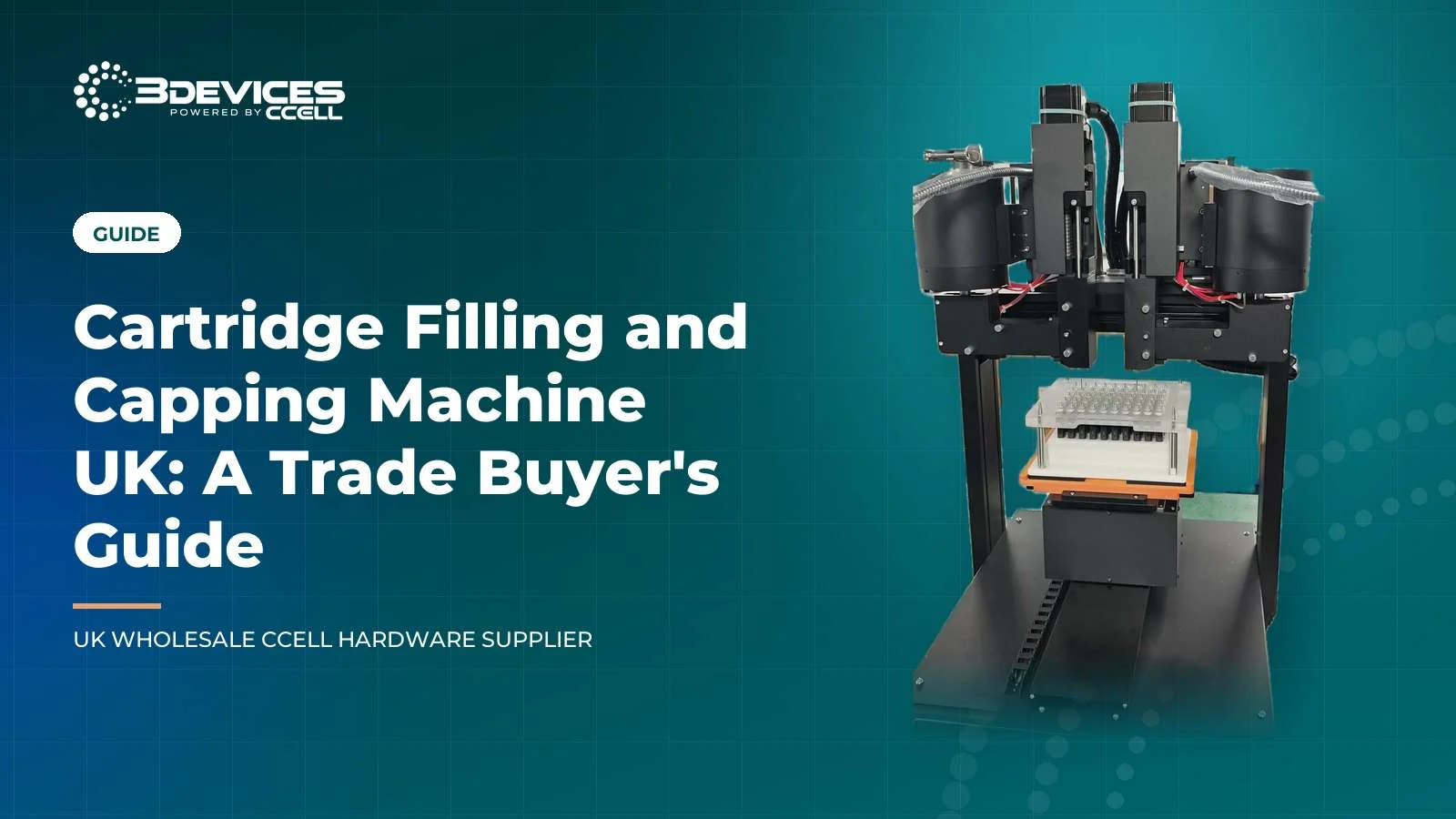
A cartridge filling and capping machine lets a licensed brand fill and close CCELL hardware in-house instead of doing it by hand or sending it to a contract filler. The machine we supply in the UK is the ZW-221S-02: two heated filling needles that fill a whole fixture tray, then a capping press that seats the mouthpieces on the entire tray in one stroke. The manufacturer states a single fill range of 0.2 to 5ml with ±1% precision, and an output of 600 to 1,500 pieces an hour depending on the fill volume. This guide is written for UK trade buyers and brands: what the machine does, which CCELL hardware its page says it suits, the workflow, the specifications we can state, and when buying one makes more sense than filling by hand.
Key takeaways
- The ZW-221S-02 fills with two needles, driven by a motor and screw, so it needs no air pump or compressor.
- Stated figures: 0.2 to 5ml per fill, ±1% precision, 600 to 1,500 pieces an hour depending on fill volume.
- One press caps a whole filled tray, so cartridges never leave their fixture between filling and capping.
- Fixtures exist for different CCELL hardware, with TH2 cartridges and all-in-ones such as the Easy Bar named on the product page. Tell us what you fill and we confirm fixtures in your quote.
- Price, lead time and what is included are given by quote, so ask for trade pricing rather than expecting a list price.
What the filling and capping machine does
The Filling and Capping Machine is sold by 3DevicesCCELL as quote-only equipment in our accessories range. It does two jobs on one production line. First it fills oil into a full tray of hardware, then a press closes the whole tray at once. Supply and support come from 3DevicesCCELL, a UK team that works with CCELL hardware every day.
The filling side is automatic. You load a fixture tray, recall a saved programme on the touch screen and press Start, and the stage lifts the tray under the two needles. The capping side is a press: the mouthpieces sit in a fixture plate, the plate turns over onto the tray of filled hardware, and the press seats every mouthpiece together with even pressure. The operator loads and unloads trays, which is why we describe it as equipment that makes a skilled person faster and more consistent, not a lights-out line.
Specifications we can state
The figures below are the manufacturer’s, taken from the user manual for model ZW-221S-02 and shown on the product page.
| Specification | Detail |
|---|---|
| Model | ZW-221S-02 |
| Single fill range | 0.2 to 5ml |
| Filling precision | ±1% |
| Output | 600 to 1,500 pieces per hour, depending on fill volume |
| Filling needles | Two, set separately, either can be switched off |
| Tank capacity | 1 L plus 1 L, heated |
| Drive | Motor and screw, no air pump |
| Control | PLC with 7-inch touch screen |
| Programme storage | 10 filling programmes |
| Power supply | AC 100-120 V or AC 200-240 V, chosen when ordering |
Some rows on the product page are still marked as coming soon: the capping machine model, dimensions and weight, certifications, warranty, price and lead time. We do not guess at those. If any of them is a requirement for your site, such as floor space, a safety file or a warranty term, ask for it in writing with your quote before you commit.
Which CCELL hardware does it suit?
The product page says the machine fills cartridges, all-in-ones and particle-free oils. It also says that fixtures exist for different CCELL hardware, and it names two examples: TH2 cartridges and all-in-one devices such as the Easy Bar. The capping footage shows a TH2 fixture with the mouthpieces on, and the all-in-one footage shows the Easy Bar tray being recalled and filled.
Beyond those named examples, we do not claim that every CCELL product has a fixture. The honest position is this: tell the team which hardware you fill, your expected volume and your delivery country, and the quote confirms the right fixtures. If you fill something not named on the page, such as a newer all-in-one, ask before you assume a fixture exists. When you add another cartridge or pod later, the team helps you fit the fixture and save its filling programme.
If you are still choosing hardware, these guides help you decide what to fill in the first place:
- CCELL TH2 cartridge comparison, for the TH2 range.
- CCELL Flexcell, Flex and Easy Bar compared, for the all-in-one named on the page.
- How to choose empty vape cartridges, for capacity, cores and fit.
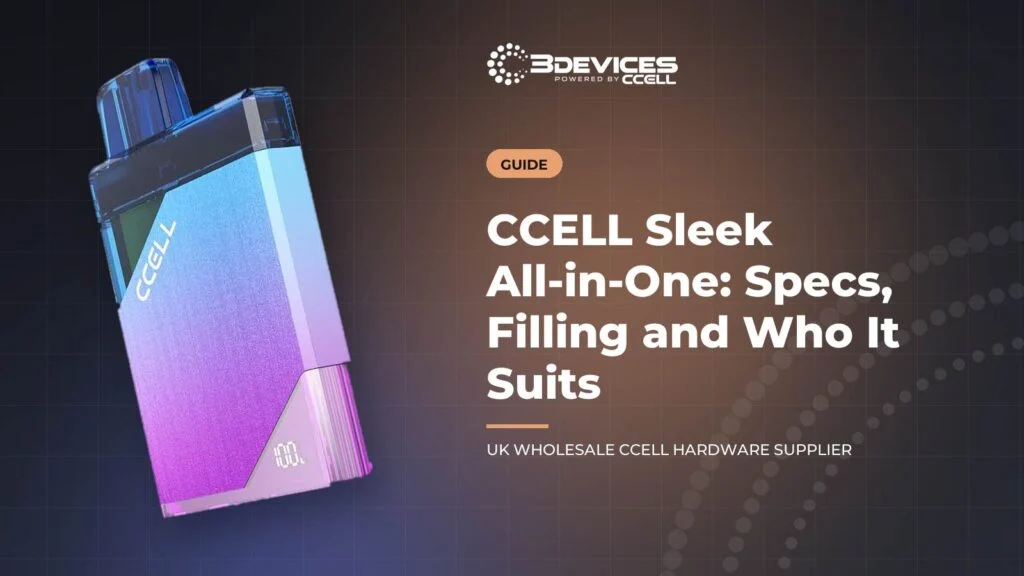
- CCELL Sleek all-in-one, a newer 3.0 all-in-one that is supplied empty for licensed filling. Ask whether a fixture is available for it.
The filling and capping workflow, step by step
The page and the supplier footage describe a production run in six stages. This is the routine your operator repeats for every tray.
- Heat. Put the oil in the tank and switch the heating on. Allow about 10 minutes for the oil to reach your set temperature. The tank is heated so the oil stays at that temperature while you work.
- Prime. Once a day, purge air from the needles before you start filling.
- Recall. Load your saved programme. The machine stores 10 filling programmes, and a programme holds the tray layout and the settings for your hardware.
- Fill. Seat the locator base and the tray, set the fill volume and press Start. The two needles step across the tray row by row and fill the whole fixture tray. Volume and speed are set per needle, so thick oils can run slower for a clean dose.
- Cap. Place the mouthpiece plate on the filled tray, slide it into the press and press Start. The press seats the mouthpieces on every piece in the fixture together, so your team never caps one by one.
- Shut down. At the end of the day, drain the remaining oil, switch the heating off, then switch the power off. Refill the tank to no more than 90 percent next time.
Setting up a new fixture is a one-off task. The supplier’s programming demo shows six steps: move the axes over the first hole, set the needle spacing with the handwheel and lock it, measure the X and Y pitch and the row count, run the point check, then save the programme to a blank file. Once saved, the programme is recalled in two taps. The product page carries four short demo videos of filling, the capping press, the all-in-one fixture and fixture programming, and they are worth watching before you decide.
Throughput: what 600 to 1,500 an hour means in practice
The manufacturer’s figure is 600 to 1,500 pieces an hour, and it depends on the fill volume you set. A larger fill takes longer per piece, so a 5ml run sits toward the lower end and a small fill sits toward the upper end. The manual also warns against chasing speed: running above the machine’s limit hurts fill precision, shakes the machine and wears it faster.
To see what that means for your plan, do the arithmetic with your own numbers. As an illustration only, a four-hour filling session at the low figure of 600 an hour is 2,400 pieces, and at the high figure of 1,500 an hour it is 6,000. Real output also depends on how fast your team loads trays, how thick your oil is, and how often you stop to change fixtures or oil. Treat the stated range as a ceiling for planning, and measure your own rate on a trial run before you quote delivery dates to your customers.
When to buy a machine and when to fill by hand
There is no universal break-even point, and we will not invent one. The decision turns on a few things you already know about your business.
| Factor | Fill by hand or outsource | Buy a machine |
|---|---|---|
| Volume | Small, occasional batches | Regular runs in the thousands |
| Consistency | Dose varies between operators | Stated ±1% precision from saved programmes |
| Hardware range | One-off or mixed formats | A few repeat products with fixtures |
| Control | Contract filler sets the schedule | You set the schedule and keep oil in-house |
| Space and power | No room for equipment | Floor space and a suitable AC supply |
| Skills | No trained operator | An operator you can train and support |
A machine usually makes sense when you fill the same few products repeatedly, when you want the same dose on every unit, and when you want to keep production and your oil in-house. Filling by hand or using a contract filler usually makes sense when you are testing a product, when batches are small, or when you do not yet have a licensed filling space, an operator or the room.
All-in-ones need particular care, because CCELL designs them for automated filling. That is a reason to plan equipment early if all-in-ones are your main format. Our guide to how to use a CCELL all-in-one covers what happens after the unit leaves your line, and our guide to filling ceramic cartridges without leaks sets out good practice for cartridges whichever way you fill.
Before you buy: a checklist for UK brands
- Your hardware. List every cartridge, pod and all-in-one you fill, with tank sizes, so fixtures can be confirmed for each.
- Your volume. Give a realistic monthly quantity and the fill size, since the fill size sets the hourly rate.
- Your oil. The page states particle-free oils. Thick oils run at a slower speed per needle, so tell us what you fill.
- Your site. Confirm floor space, the correct supply (AC 100-120 V or AC 200-240 V) and who will operate it.
- Your compliance. Filling and selling filled products carries legal obligations, and the legal position is yours to confirm. Read our notes on cartridge and packaging labels and on child-resistant hardware and packaging, and take advice from your own legal adviser.
- The missing rows. Ask for dimensions, weight, certifications, warranty and lead time in your quote.
Support after the sale
You buy from a UK team, and support terms, parts pricing and response times are agreed in writing with your quote. The product page lists what is offered:
- Set-up and commissioning, with your cartridges, fixtures and oil, and a check of the first trays with you.
- Operator training, using narrated demo videos, the touch-screen walkthrough and the English user manual.
- Help fitting new fixtures and saving programmes when you add another CCELL cartridge or pod.
- Maintenance guidance, spare parts (filling needles, check valves, seals, 20 A fuses and the positioning switch) and first-line troubleshooting.
Keeping the machine running
The routine care comes from the manufacturer’s manual. Add lubricating grease to the guide rail and the oiling screw once a month, or every six months in a clean room. Shut down properly every day by draining the remaining oil, switching the heating off, then the power. Do not run above the limit to chase speed.
The manual also lists common faults. If there is no power, check the power switch on the cabinet door and in the distribution box, replace the 20 A fuse, and if the indicator stays off the switching power supply needs replacing. If there is no oil or the fill is uneven, the tank may be empty, the check valve worn, the seals leaking at the injection pump, or the heating set too low. If the injector keeps returning, the positioning switch is damaged and needs replacing. If your filled units leak after filling, our guide to CCELL cartridge leaking covers the hardware side.
How to ask for a price
The machine has no list price, because it depends on the fixtures, the power supply and the support you need. Use the buy button on the product page, or the contact page, and tell the team the CCELL hardware you fill, your expected volume and your delivery country. The reply gives the price, lead time and what is included. For how our trade orders work in general, read our guide to CCELL wholesale in the UK. If you want to brand the hardware you fill, see our guide to laser engraving and private-label hardware.
FAQ
What is a cartridge filling and capping machine?
It is equipment that fills oil into hardware and then closes it. The ZW-221S-02 fills a full fixture tray with two needles and then caps the whole tray with a press, so a licensed brand can fill and cap CCELL cartridges and all-in-ones in-house.
What are the filling machine specifications?
It fills 0.2 to 5ml per needle with ±1% precision at 600 to 1,500 pieces an hour, depending on fill volume. It has two needles, a heated 1 L plus 1 L tank, a motor and screw drive with no air pump, and a 7-inch touch screen with 10 saved programmes. Power is AC 100-120 V or AC 200-240 V, chosen when you order.
Which CCELL hardware can it fill and cap?
The product page says it fills cartridges, all-in-ones and particle-free oils, and that fixtures exist for different CCELL hardware, such as TH2 cartridges and the Easy Bar. Tell the team what you fill and the quote confirms the right fixtures.
How many cartridges can it fill an hour?
The manufacturer states 600 to 1,500 pieces an hour depending on the fill volume. Your real rate also depends on your oil, your operator and how often you change fixtures, so test on a trial run.
Does it need an air compressor?
No. It uses a motor and screw drive, so there is no air pump and no compressor on your floor.
Should I buy a machine or fill by hand?
A machine suits regular runs of the same few products where you want the same dose each time and want production in-house. Hand filling or a contract filler suits small or one-off batches, or a site without space, an operator or a licensed filling area. Compare your own volume against the stated hourly range before you decide.
What does it cost and what support comes with it?
There is no list price. Ask for trade pricing and give your hardware, volume and delivery country, and we reply with the price, lead time and what is included. Support covers set-up, operator training, fixtures and programmes, maintenance guidance, spare parts and first-line troubleshooting, with terms agreed in writing.