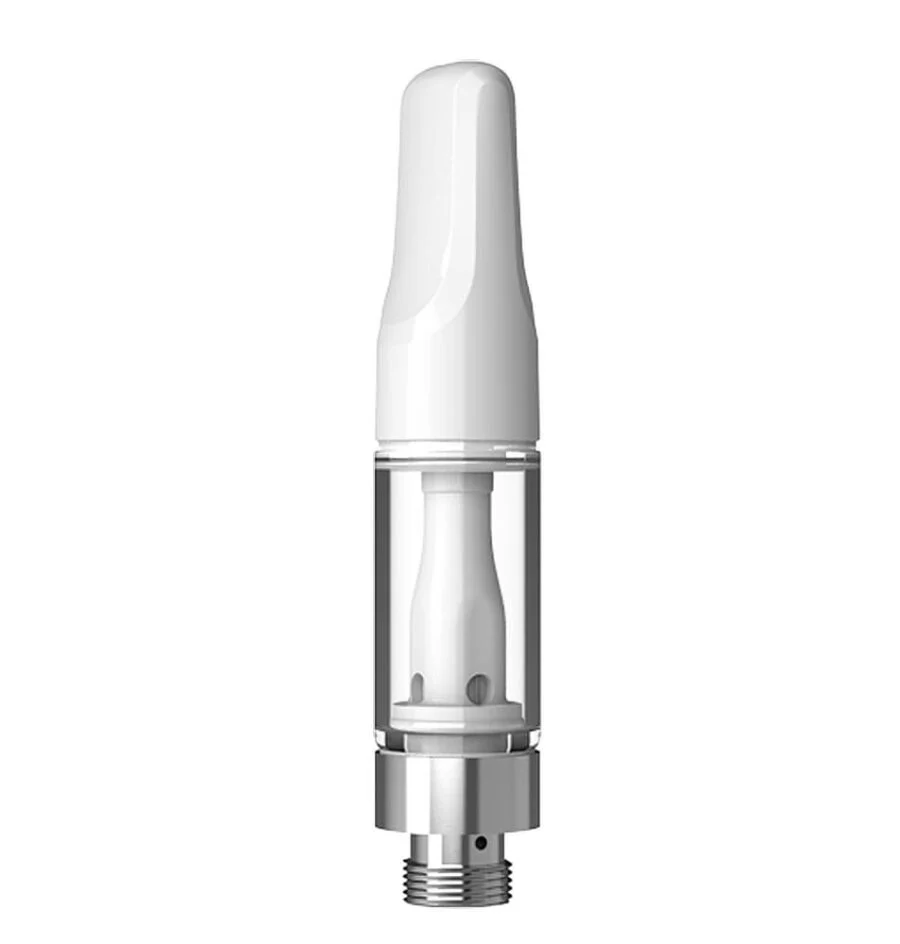
The CCELL Kera cartridge is a full-ceramic 510 cartridge with a borosilicate glass tank, a zirconia ceramic centre post and a snap-fit ceramic mouthpiece, and it sits beside Kera RR and Ceramic-EVOMAX as the three ceramic-led options in the range. Kera lists a 1.4 ohm resistance in 0.5ml and 1ml. Kera RR is a single 0.5ml listing defined by its 2.5mm inlet. Ceramic-EVOMAX pairs a 1.7Ω EVOMAX element with a ceramic centre post and is capped 50 pieces at a time. This guide sets the three side by side for licensed filling operations, using only the spec tables and options on each live product page.
Key takeaways
- Kera is 1.4 ohm with 60% less capping force than the first generation. Ceramic-EVOMAX is 1.7Ω with batch capping of 50.
- Kera RR has one option only: 0.5ml, White, 2.5mm inlet. It is 1.4 ohm, like standard Kera.
- The Ceramic-EVOMAX body is 11.0mm, wider than Kera at 10.5mm, so check tight battery slots.
- Kera and Kera RR use CCELL’s proprietary ceramic heating core. Ceramic-EVOMAX uses EVOMAX.
CCELL Kera, Kera RR and Ceramic-EVOMAX side by side
The three listings share glass and ceramic parts but differ in resistance, aperture and what each product page publishes. The first table compares Kera with Ceramic-EVOMAX, which have matching spec lines.
| Spec line | Kera | Ceramic-EVOMAX |
|---|---|---|
| Tank volume | 0.5ml / 1ml | 0.5ml / 1ml in the spec list, 2.0ml added in shop options |
| Dimensions | 10.5 x 53.1H / 64.6H mm | Φ11.0 x 53.9H / 65.2H mm |
| Resistance | 1.4 ohm | 1.7Ω |
| Heating core | Proprietary CCELL ceramic | EVOMAX |
| Housing or body | Borosilicate glass | Borosilicate glass |
| Centre post | Zirconia ceramic | Ceramic |
Kera RR is kept out of that grid because it is a single 0.5ml listing with its own inlet size.
| Kera RR spec line | Detail | Source |
|---|---|---|
| Tank volume | 0.5ml | Spec list |
| Inlet hole size | 2.5mm | Spec list and variation option |
| Mouthpiece colour | White | Spec list |
| Thread and core | Standard 510, 1.4 ohm, proprietary CCELL ceramic | Spec list |
Reading the CCELL Kera cartridge spec sheet
The 1.4 ohm cartridge with a zirconia ceramic post is standard Kera. Its page lists resistance, materials, dimensions, capping force, output figures and standard 510 threading, which makes it straightforward to write into a hardware specification.
Resistance and heating core
At 1.4 ohm, Kera sits at a lower resistance than the 1.7Ω Ceramic-EVOMAX, and its heating core is CCELL’s proprietary ceramic rather than EVOMAX. The two will not behave identically on the same battery setting, so validate each on the battery you plan to recommend. The Kera page also lists distillates under oil capability, which is a useful starting point for oil matching.
Materials that touch the oil
Kera’s oil path is glass and ceramic throughout: borosilicate glass for the housing, zirconia ceramic for the centre post and ceramic again for the snap-fit mouthpiece. For buyers who want ceramic at the post and mouthpiece, that combination is why Kera appears on shortlists. The mouthpiece is White only.
Capping force and output figures
Kera’s snap-fit ceramic mouthpiece needs 60% less capping force than the first generation. Ceramic parts are less forgiving than plastic, so a lower seating force can mean fewer broken mouthpieces over a long shift. Check the seal on your own units when you set up the press.
The spec sheet also lists 20% larger clouds and an average of 5.4mg TPM per puff. These are CCELL lab figures on THC distillate, so treat them as a comparison point within the CCELL range.
Sizes and packaging depth
The 0.5ml and 1ml versions share the 10.5mm diameter, with heights of 53.1mm and 64.6mm. A two-volume range needs two insert depths, or one insert sized for the taller cartridge.
Kera RR: one 0.5ml option with a 2.5mm inlet
The Kera RR 0.5ml cartridge is a deliberately narrow listing with a single tank size, a single colour and a single inlet option written as 0.5ml 2.5mm.
What the inlet figure tells a filler
The inlet hole is where oil enters the heating element, and a larger hole lets dense oil in more quickly. That can reduce dry hits on thick fills, but it can raise leak risk with thin oil. A runny oil is unlikely to suit a 2.5mm inlet, so match the hole to the oil and test before scaling.
Our explainer on matching oil viscosity to intake aperture covers the reasoning in more depth.
Ordering and troubleshooting Kera RR
Write the inlet option exactly as 0.5ml 2.5mm so the picking team cannot swap in standard Kera. Where a range also needs a 1ml ceramic-post cartridge, standard Kera covers that volume. If a Kera RR leaks with a thin fill, reduce the fill, leave an air gap and store upright. If the mouthpiece floods, the oil may be too thin for that inlet.
Ceramic-EVOMAX: EVOMAX element with a ceramic oil path
A 1.7Ω EVOMAX element with a ceramic oil path is what Ceramic-EVOMAX offers. Its spec list gives 0.5ml or 1ml, Φ11.0 x 53.9H or 65.2H mm, a 4 x Φ2mm aperture, a snap-fit mouthpiece, a borosilicate glass body and a ceramic centre post.
What the feature panels add
The CCELL feature panels add four points that matter to a production team:
- Full ceramic design. The oil path is glass and ceramic rather than metal.
- Oil compatibility. CCELL lists it as compatible with all oils, naming live rosins and liquid diamonds.
- Mouthpiece colours. Black and White are shop options, and custom ceramic colours are offered by agreement.
- Batch capping. The snap-fit design allows capping 50 pieces at a time.
Treat the oil compatibility line as a ceiling, not a promise. Fill quality, battery voltage and test temperature all affect the result, and the CCELL claims are not our test results.
Three tank sizes and a wider body
Ceramic-EVOMAX is the one listing here with three tank sizes in its shop options: 0.5ml, 1.0ml and 2.0ml. The spec list gives dimensions for the two smaller sizes, so confirm the size you need on the purchase order.
The body is Φ11.0mm, slightly wider than Kera. Slot-style batteries such as the CCELL Stylo and CCELL Kap are listed up to 14mm, while a drop-in model such as the CCELL Palm Pro should be test-fitted first.
Where each core sits in the CCELL range
Kera and Kera RR use CCELL’s proprietary ceramic core, while Ceramic-EVOMAX uses EVOMAX. The Ceramic-EVOMAX page sets out how CCELL positions each heating generation, and the table repeats that positioning without adding claims of our own.
| Heating core | Introduced | CCELL positions it for |
|---|---|---|
| SE ceramic | 2016 | Distillate and pourable oils |
| EVO | 2022 | Distillate and terpene-rich oils |
| EVOMAX | December 2023 | All oil types |
| 3.0 Bio-Heating | December 2024 | All oil types, higher capacities |
The practical reading for a filler is simple. Standard Kera is the cartridge to test first when the brief is a ceramic finish on a distillate oil, and Ceramic-EVOMAX is the one to test when the same finish must cope with thicker oils. Positioning is a starting point only, so the pass or fail decision should always come from your own fill.
Who each cartridge suits
- Kera: brands selling on a premium white ceramic finish, and filling lines that care about capping force.
- Kera RR: teams that validate hardware themselves, work with thick oils and want one size and one colour to manage.
- Ceramic-EVOMAX: flavour-led or thick-extract ranges that want an all-ceramic oil path and a choice of three tank sizes.
Kera is not the right pick if you need a 2ml tank, a mouthpiece colour choice or a postless design. Its tank is 0.5ml or 1ml and its mouthpiece is white only.
Choosing between Kera and Ceramic-EVOMAX
These are guidelines for building a test plan, not rules about any specific oil.
| If your priority is | Start testing with | Why |
|---|---|---|
| Lower capping force for press set-up | Kera | 60% less than the first generation |
| A 1.4 ohm cartridge | Kera | Lowest resistance of the three listed |
| EVOMAX heating at 1.7Ω | Ceramic-EVOMAX | Listed for all oils |
| Batch capping 50 at a time | Ceramic-EVOMAX | Snap-fit design |
| Thick oil with a larger inlet | Kera RR | 2.5mm inlet |
For the heating-core background, read our EVOMAX vs SE ceramic core comparison. If you are weighing glass cartridges with stainless steel posts instead, see the TH2 cartridge comparison.
Pairing a battery and checking fit
A cartridge is only half the product, so record the published resistance on your hardware specification and choose a battery whose voltage steps match the settings you validate. All three listings use standard 510 threading.
| Battery | Connection | Named on page for |
|---|---|---|
| CCELL Stylo | Slot, up to 14mm | Kera, Kera RR, Ceramic-EVOMAX |
| CCELL Kap | Slot, up to 14mm | Ceramic-EVOMAX |
| CCELL Sandwave | Drop-in magnetic with nut | Kera RR |
| CCELL M4 | 510 thread | Kera RR |
| CCELL Rizo | Magnetic adaptor | Kera |
| CCELL Fino | Drop-in magnetic | Kera |
The CCELL battery range lists voltage settings for each model, and our cartridge and battery compatibility guide explains how thread, width and connection combine.
Filling and capping ceramic cartridges
Ceramic mouthpieces and snap-fit caps reward a consistent process. The product pages give the same basic routine for all three listings.
- Hold the cartridge upright and check the inlet or aperture is clear.
- Fill to your validated line, leaving a small air gap.
- Let the oil settle into the ceramic core before capping.
- Fit the mouthpiece with a capping tool and test-fire before packing.
Our guide on filling ceramic cartridges without leaks sets out headspace and cap timing in full. If a cartridge leaks or clogs in testing, the cartridge leaking guide and the clogged cartridge guide list the common causes.
Testing, specification and purchase orders
A test round is more useful when the questions are written down before the cartridges arrive. Record these against every cartridge:
- Seal after capping. Check that every cap seats at your press setting and none lift after a day upright.
- Behaviour at your voltage. Run Kera and Ceramic-EVOMAX on the same battery step and note any difference your team can detect.
- Fill line visibility. Both list borosilicate glass, so check how the fill line reads under your lighting and label artwork.
- Inlet response. For Kera RR, note how quickly your oil reaches the element after filling.
Keep the results with the batch record so a later reorder can be checked against the same notes. Once testing is signed off, put these lines on the hardware specification and the purchase order:
- Listing name and tank size exactly as ordered: Kera, Kera RR or Ceramic-EVOMAX.
- Published resistance (Kera 1.4 ohm, Ceramic-EVOMAX 1.7Ω) and the band you accept on incoming stock.
- Mouthpiece colour: White on Kera and Kera RR, Black or White on Ceramic-EVOMAX.
- For Kera RR, the inlet option as written: 0.5ml 2.5mm.
- Your capping press setting, battery and validated voltage step.
For the wider case for ceramic cores, see our news piece on ceramic core hardware for wholesale buyers. All three listings sit in the CCELL cartridge range next to the TH2, M6T-SE and CCELL 3.0 cartridges. We supply these cartridges empty from Bolton to licensed UK businesses, and approvals for the filled product stay with the buyer. Send your shortlist, volumes and mouthpiece colours through the 3DevicesCCELL contact form.
FAQ
What resistance is the CCELL Kera?
The Kera spec sheet lists 1.4 ohm. That is lower than the 1.7Ω listed for Ceramic-EVOMAX, so the two should be validated separately on the battery you plan to recommend. Kera RR is also 1.4 ohm.
What centre post does Kera use?
Kera uses a zirconia ceramic centre post, with a snap-fit ceramic mouthpiece and a borosilicate glass housing. The mouthpiece is White only. Ceramic-EVOMAX uses a ceramic post, while the TH2 range uses other post materials, so check the listing when you specify a cartridge.
What does the Kera RR listing specify?
Kera RR is a 0.5ml cartridge in White with a 2.5mm inlet, 1.4 ohm resistance, a borosilicate glass tank, a zirconia ceramic post and standard 510 threading, sold as a single option. It uses CCELL’s proprietary ceramic heating core. Validate it on your own oil before scaling.
Can Ceramic-EVOMAX be capped in batches?
Yes. The product page gives batch capping of 50 pieces at a time for its snap-fit mouthpiece. Compare that with your current capping step before you set a production schedule, and check your press setting on a small batch first.
Is Ceramic-EVOMAX the same resistance as Kera?
No. Ceramic-EVOMAX lists 1.7Ω and Kera lists 1.4 ohm, and they use different heating cores, EVOMAX and CCELL’s proprietary ceramic. Run both on the same battery step during testing and note any difference, because a single voltage setting will not suit both equally.
Do Kera cartridges fit standard 510 batteries?
Yes, all three listings have standard 510 threading. Check the body width on tight slots, because Ceramic-EVOMAX is 11.0mm against Kera’s 10.5mm. Slot-style batteries such as the Stylo and Kap are listed up to 14mm, so they take either body.